Issued by SOUNDREBEL Poland
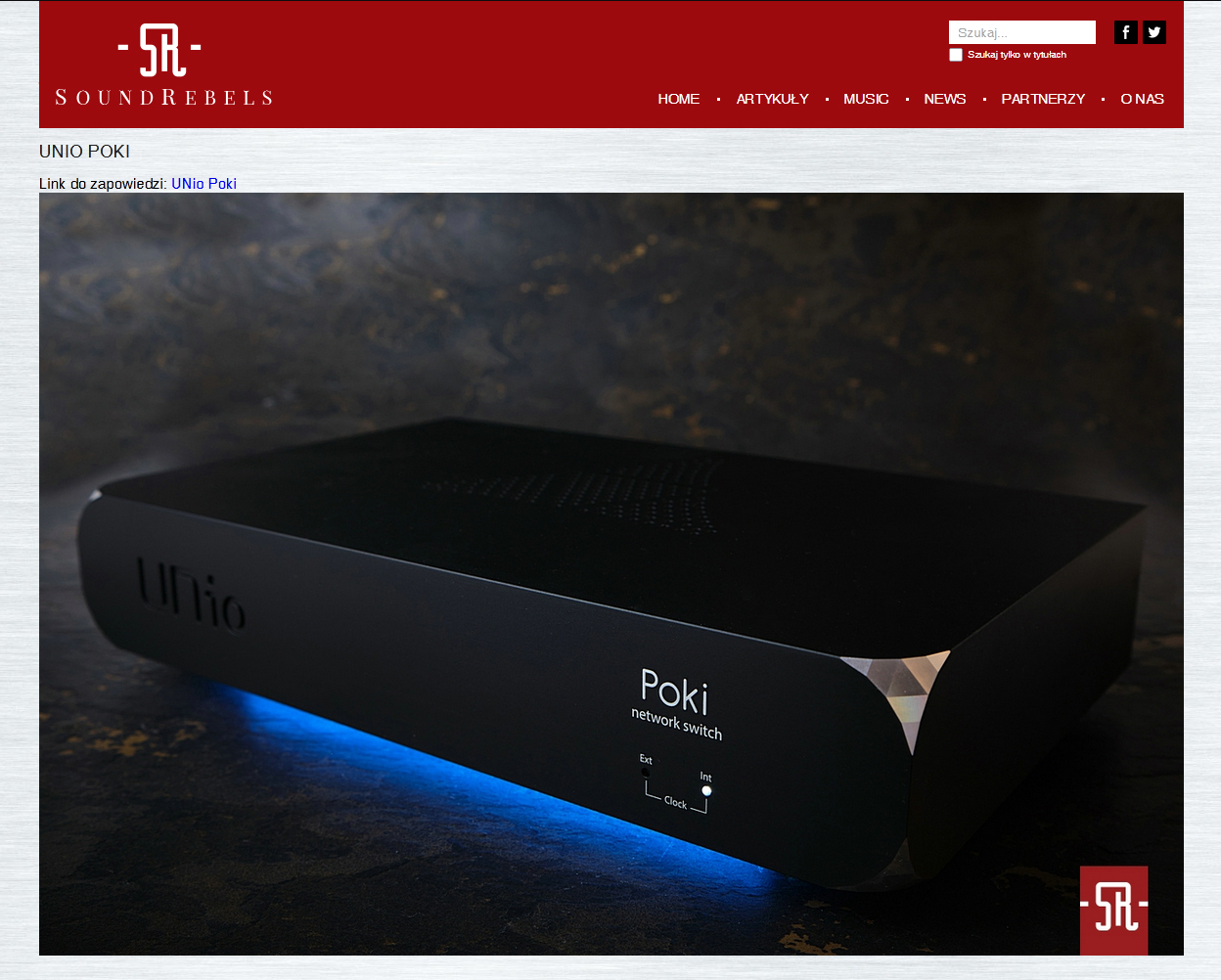
The UNio Poki is a high-end audiophile network switch from Hong Kong manufacturer ungnoi, recently introduced to the Polish market by AudioPhase—the same distributor known for AudioPhase loudspeakers. Designed specifically for demanding digital streaming setups, the Poki aims to elevate the performance of file-based audio systems by delivering cleaner, more stable, and better-timed network signal distribution.
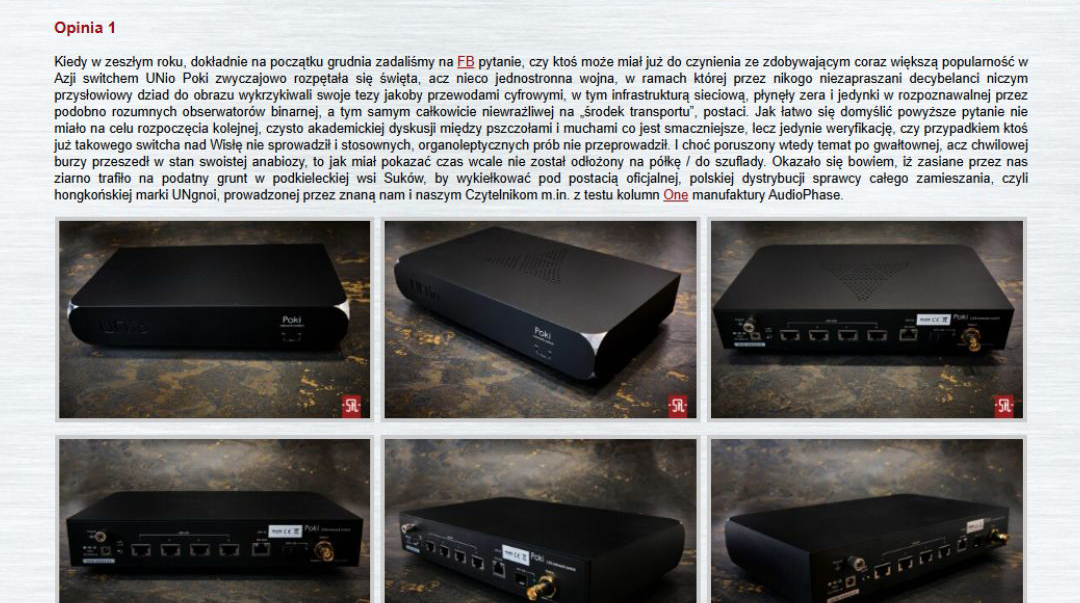
Physically, the Poki impresses with its solid build quality. Machined from a single block of aluminum, the chassis is available in satin silver or black. It features elegant "Rose Cutting" style chamfered corners and attractive blue underbody LED illumination, which can be switched off if preferred. Unlike typical consumer switches with rows of blinking port LEDs, the front panel remains clean and minimalist, showing only the engraved brand logo, model designation, and two small LEDs indicating internal or external clock usage. The top panel incorporates a finely perforated rosette pattern for ventilation. On the rear, users will find a grounding terminal, a 12V DC power input (wall wart included), an illumination switch, four 2.5 Gbps Ethernet ports, a dedicated 1 Gbps Ethernet port for audio devices, a 10 Gbps SFP optical port, and a 10 MHz 50Ω BNC input for an external master clock.
Internally, the Poki utilizes a custom high-quality PCB rather than a modified commercial off-the-shelf board. It is equipped with ungnoi's own CHRONOS Class ultra-low phase noise clock and a sophisticated multi-stage DC power supply featuring four independent filters for the 0.95V, 1.1V, 3.3V, and 5V rails. These specifications underscore its serious audiophile intent.
Marcin Olszewski's Impressions:
In his detailed listening test, Marcin Olszewski found the sonic impact of the UNio Poki to be both obvious and significant. Compared to the popular Silent Angel Bonn N8 and even a QSA switch, the Poki stood out clearly. He described its character as exceptionally fast and agile, with outstanding transient response and rhythmic zest. This quickness reminded him of modern high-performance electric sports cars such as the MG Cyberster or Xiaomi SU7.
Initially, he perceived a slight upward shift in tonal balance due to the speed, but extended listening revealed this was not caused by thinned bass or excessive sharpness. Instead, the bass was exceptionally well-controlled and differentiated—extending deep into the lowest registers with full energetic potential, delivering powerful, fast "low-kicks" rather than soft, bloated rumbling. The treble was bold, crystal-clear, open, and highly airy, while the midrange remained detailed and smooth without becoming harsh or fatiguing.
Olszewski noted that the Poki excels at "clearing the air" in congested recordings. In dense, heavy rock tracks like Castle Rat's The Bestiary (featuring fiery vocalist/guitarist Riley Pinkerton), it provided precise foreground placement, excellent layering, and a powerful yet nuanced bass foundation—nothing smeared or oversimplified. On Cynthia Erivo's I Forgive You, it delivered highly realistic, tangible vocals with natural presence, as if listening to raw studio takes rather than a compressed commercial mix. Even in minimalist jazz works such as Michel Godard and Roberto Ottaviano's Astrolabio mistico, the Poki demonstrated superb handling of silence and micro-details.
He concluded that while the Poki is not the cheapest option, it represents clear sonic progress in most streaming systems. Listeners who prefer a softer, more romantic, or veiled presentation might find it too direct and resolute. However, Olszewski emphasized that any restriction of dynamics or resolution at the source inevitably compromises later stages. He recommends powering the Poki with a quality linear power supply and adding an external clock for further refinement.
Jacek Pazio's Impressions:
Jacek Pazio approached the review from a more measured perspective but reached equally positive conclusions. He observed two primary improvements: enhanced low-frequency performance and a cleaner overall presentation. The bass gained better depth, tighter control, richer information, and stronger impact. Simultaneously, the background became noticeably cleaner, resulting in greater directness, improved realism, and a more open soundstage.
Importantly, these changes occurred without disrupting tonal neutrality. The midrange remained largely untouched, confirming that the Poki works on a fundamental, uncolored level. With RGG's jazz album Szymanowski, the switch refined the portrayal of silence, note decay, and spatial placement, making the music feel closer to live reality. On Rammstein's Zeit, it improved articulation, drive, and rhythmic excitement, preserving the music's aggression and unpredictability while enhancing listener engagement.
Pazio stressed that the UNio Poki delivers meaningful benefits across different system aesthetics and musical genres. Unless a system is already severely compromised, inserting the Poki should bring clear, positive results. He described it as "pure good" for serious streaming setups.

Final Thoughts:
Both reviewers agree that the UNio Poki is a highly capable and musically rewarding network switch. It consistently improves speed, clarity, transient accuracy, bass authority, and overall resolution while maintaining natural musical flow. In the increasingly crowded audiophile network switch market, the Poki distinguishes itself through strong engineering, attractive design, and genuine sonic contribution at a relatively accessible price point.
For best performance, users are encouraged to use a high-quality linear power supply and experiment with external master clocks. Whether used in a high-resolution digital front-end or as part of a mixed analog-digital system, the UNio Poki appears to be a worthwhile upgrade for discerning listeners seeking greater insight and enjoyment from their streamed music libraries.
This English summary is compiled from the two original Polish reviews by Marcin Olszewski and Jacek Pazio.


